Why EDR telemetry drives SIEM ingestion costs
Endpoint Detection and Response (EDR) tools generate rich telemetry for threat hunting and investigations. When exported directly to SIEM platforms that bill on ingestion and retention, volume can drive significant costs. Teams often want full fidelity for investigations while avoiding downstream charges on duplicates or low-value events.
EDR telemetry (for example, CrowdStrike) is commonly exported via features like Falcon Data Replicator (FDR) and Event Streams into analytics platforms such as Splunk or into archives and data platforms. In many deployments, LogZilla serves as the data lake through its searchable archive. This flexibility is useful; teams typically manage only the forwarded volume into cost-sensitive SIEMs, while keeping full-fidelity data economically in LogZilla.
What EDR exports look like (e.g., CrowdStrike)
- Falcon Data Replicator (FDR) forwards enriched, near real-time events to external storage or log platforms. CrowdStrike provides a Splunk add‑on for indexing FDR data.
- Event Streams exposes streaming event data; a Splunk add‑on collects from the Event Streams API into Splunk.
- Falcon LogScale (next‑gen SIEM/log management) is another destination for telemetry where ingestion and retention planning matters.
Falcon Data Replicator forwards enriched events to external storage or log platforms for indexing and analysis.
Falcon Data Replicator Add-on for Splunk allows retrieving FDR data and indexing in Splunk.
Falcon Event Streams Add-on for Splunk collects data from the Event Streams API and sends it to Splunk to index.
Falcon LogScale is a next‑gen SIEM/log management solution offered by CrowdStrike.
These options demonstrate why ingest-time processing is essential: the data is valuable, but indiscriminate forwarding to cost-sensitive platforms can impact budget without improving outcomes.
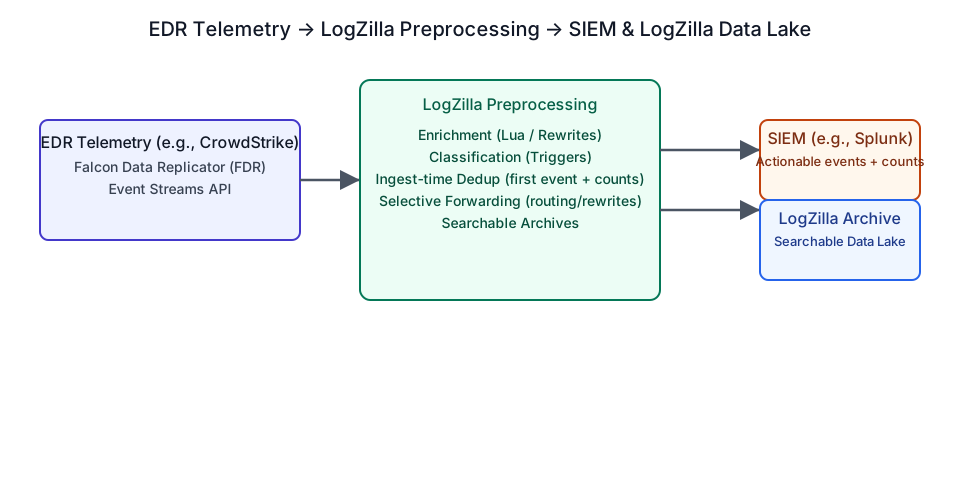
How LogZilla reduces ingestion without losing fidelity
LogZilla acts as a first hop to transform EDR telemetry before it reaches cost-sensitive systems:
- Ingest-time deduplication with immediate-first behavior. The first occurrence forwards immediately; duplicates are counted and summarized. Analysts keep visibility while avoiding redundant ingest charges.
- Actionable vs. non-actionable classification using triggers. Tag and route events that need correlation and alerting, while keeping full history in LogZilla for audit and search.
- Selective forwarding with context. Forward only what SIEMs need, enriched with occurrence counts and original context. Send other flows to LogZilla’s searchable archive (serving as the data lake) or to an external data lake as needed.
- Searchable archives. Retain complete telemetry in LogZilla for long-term access without rehydration steps.
LogZilla performs ingest-time deduplication with immediate-first behavior and summary counts.
LogZilla can forward to downstream syslog receivers and other systems with configurable routing.
LogZilla maintains searchable archives for long-term retention without rehydration.
Result: higher‑quality signals reach the SIEM with far fewer redundant events. Full fidelity remains available in LogZilla for investigations and compliance.
Implementation blueprint (EDR → LogZilla → SIEM)
- Export EDR telemetry (for example, FDR or Event Streams) to LogZilla as the first hop.
- Apply ingest-time deduplication and enrichment; add device/user/asset context.
- Classify events (Actionable/Non‑actionable) and define routing rules.
- Forward only actionable events to SIEM with counts and context; route the rest to LogZilla’s searchable archive (acting as the data lake) or to an external data lake as needed; full history remains available in LogZilla.
- Track forwarded volume, duplicate ratio, and analyst effort saved.
LogZilla licensing is based on Events Per Day (EPD).
Metrics to track
- Daily ingestion volume before/after preprocessing
- Duplicate elimination rate and summary event counts
- Forwarded vs. retained volume by source and event type
- Incident triage time and false-positive rate
AI-Powered EDR Analysis
LogZilla AI Copilot transforms how security teams analyze EDR telemetry:
Traditional EDR Analysis
Without AI, analysts must:
- Write complex queries to filter EDR events
- Manually correlate events across endpoints
- Research threat intelligence for detected IOCs
- Determine remediation steps for each finding
- Document findings for compliance
Time per investigation: 30-60 minutes
With LogZilla AI Copilot
Analysis workflow:
Query: "Analyze CrowdStrike events from the last 4 hours. Identify threats, correlate attack patterns across endpoints, and provide remediation priorities."
AI Response includes:
- Threat summary with severity rankings
- Attack chain reconstruction across endpoints
- IOC extraction with threat intelligence enrichment
- MITRE ATT&CK technique mapping
- Vendor-specific remediation commands
Time per investigation: 2-5 minutes
EDR-Specific AI Queries
| Analysis Need | AI Query |
|---|---|
| Lateral movement detection | "Show lateral movement patterns in EDR events" |
| Malware correlation | "Correlate malware detections across endpoints" |
| Privilege escalation | "Identify privilege escalation attempts" |
| Persistence mechanisms | "Find persistence mechanisms in endpoint logs" |
Cost Comparison: Traditional vs. AI-Enhanced
| Metric | Traditional SIEM | LogZilla + AI |
|---|---|---|
| Daily EDR ingestion cost | $2,400 (at $0.10/GB) | $240 (90% reduction) |
| Analyst time per investigation | 45 minutes | 5 minutes |
| Investigations per analyst/day | 10 | 50 |
| False positive rate | 40% | 12% |
| Mean time to detect | 4 hours | 15 minutes |
Annual Savings Example
Environment: 5,000 endpoints, 24 GB/day EDR telemetry
| Cost Category | Traditional | With LogZilla |
|---|---|---|
| SIEM ingestion | $876,000/year | $87,600/year |
| Analyst FTE (3 analysts) | $450,000/year | $150,000/year (1 analyst) |
| Total | $1,326,000 | $237,600 |
| Savings | $1,088,400 (82%) |
Integration with CrowdStrike Falcon
LogZilla integrates with CrowdStrike through multiple methods:
Falcon Data Replicator (FDR)
- Configure FDR to forward to LogZilla
- LogZilla applies deduplication and enrichment
- Forward security-relevant events to SIEM
- Retain full telemetry in LogZilla archive
Event Streams API
- Real-time event streaming to LogZilla
- Immediate AI analysis of incoming events
- Automated alerting for critical detections
- Correlation with other log sources
Falcon LogScale Integration
- LogZilla preprocesses before LogScale ingestion
- Reduce LogScale costs through deduplication
- Maintain full fidelity in LogZilla
- AI analysis available in both platforms
Other EDR Platform Support
LogZilla integrates with all major EDR platforms:
| EDR Platform | Integration Method | AI Analysis |
|---|---|---|
| CrowdStrike Falcon | FDR, Event Streams | Full support |
| Microsoft Defender | Event Hub, Syslog | Full support |
| SentinelOne | Syslog, API | Full support |
| Carbon Black | Syslog, API | Full support |
| Palo Alto Cortex XDR | Syslog | Full support |
| Trend Micro | Syslog, API | Full support |
Multi-EDR Correlation
Organizations running multiple EDR platforms benefit from unified analysis:
AI Query: "Correlate threat detections across CrowdStrike and Defender for the last 24 hours. Identify overlapping detections and gaps in coverage."
AI Response includes:
- Unified threat timeline across platforms
- Detection overlap analysis
- Coverage gap identification
- Consolidated remediation priorities
Implementation Checklist
- Configure EDR export to LogZilla
- Apply deduplication and enrichment rules
- Define actionable vs. archival classification
- Configure SIEM forwarding for actionable events
- Enable AI Copilot for threat analysis
- Establish baseline metrics for ROI tracking
- Tune policies based on measured results
Common EDR Telemetry Challenges Solved
Organizations face predictable challenges with EDR telemetry. LogZilla addresses each:
Challenge: Volume Spikes During Incidents
During security incidents, EDR telemetry volume can spike 10-100x, causing SIEM cost overruns.
Solution: LogZilla's deduplication handles volume spikes without forwarding redundant events. Full fidelity remains in LogZilla for investigation.
Challenge: Noisy Telemetry
EDR platforms generate events for every process, file, and network connection. Most are benign.
Solution: AI-powered classification identifies actionable events. Routine telemetry archives to LogZilla without SIEM forwarding.
Challenge: Cross-Platform Correlation
Security teams struggle to correlate EDR events with network, cloud, and application logs.
Solution: LogZilla unifies all log sources. AI correlates EDR detections with related events across the environment.
Micro-FAQ
How can EDR exports increase SIEM costs?
When SIEMs bill per ingested GB or event, high‑volume telemetry increases daily charges and long‑term retention costs.
Does deduplication lose important evidence?
No. LogZilla forwards the first occurrence immediately and tracks accurate occurrence counts for duplicates. Full history remains searchable.
Can teams still hunt across all telemetry?
Yes. Keep complete data in LogZilla. Forward only security‑relevant events to cost‑sensitive systems.
Do Splunk add‑ons change ingest-based billing?
Add‑ons simplify collection. Preprocessing upstream is what reduces volume before ingest‑based billing applies.
Next Steps
Route EDR telemetry into LogZilla first, then forward only what SIEMs need with context and counts. Measure forwarded volume, duplicate rates, and analyst time savings to tune policies over time. Enable AI Copilot for automated threat analysis and faster incident response.